What Is Gravity?
Gravity is a fundamental force in the universe that governs the attraction between objects with mass. Beyond visible phenomena, gravity operates in complex ways that influence celestial bodies, space-time, and even the structure of the universe itself.
This article examines the principles of gravity, its unseen mechanisms, and its significance in both theoretical and practical contexts.
Background or Context
The concept of gravity has evolved significantly since its initial formulations. Sir Isaac Newton first described gravity in the late 17th century as a universal force acting at a distance.
Newton’s law of universal gravitation posited that every mass attracts every other mass proportional to their masses and inversely proportional to the square of the distance between them. Albert Einstein further advanced the understanding of gravity with his General Theory of Relativity in the early 20th century.
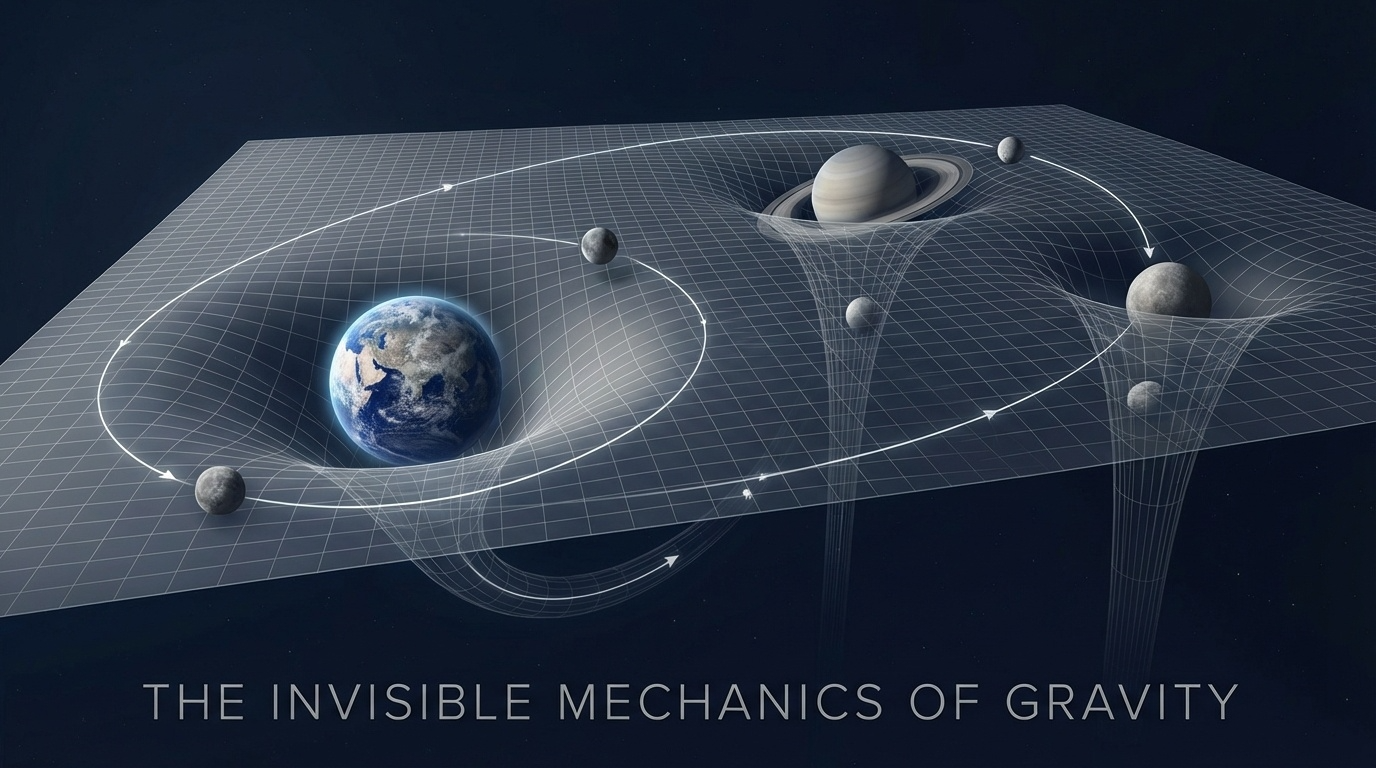
This theory described gravity not as a force but as a curvature of space-time caused by mass. These foundational ideas have shaped contemporary physics, contributing to the study of galaxies, black holes, and the overall structure of the cosmos.
How It Works or Why It Matters
Gravity operates on multiple levels. At its core, it is an attractive force that acts between all masses. On Earth, gravity gives objects weight, pulling them towards the center of the planet. This force operates through gravitational fields, which extend infinitely, though their strength diminishes with distance.
For larger astronomical structures, gravity influences the orbits of planets, the formation of stars, and the dynamics of galaxies. On a more fundamental level, gravity shapes the fabric of space-time itself, demonstrating its role in the expansion of the universe.
Key Factors, Components, or Characteristics
Several key aspects characterize gravity and its influence:
- Mass: The strength of the gravitational force is directly proportional to the mass of an object.
- Distance: The gravitational force decreases with the square of the distance between objects, following an inverse-square law.
- Space-Time Curvature: In Einstein’s framework, massive objects cause a curvature in space-time, influencing the motion of other objects.
- Gravitational Waves: Disturbances in space-time caused by acceleration of massive objects, confirmed by LIGO, demonstrating gravity’s dynamic nature.
- Dark Matter: Approximately 85% of the universe’s mass is thought to comprise dark matter, which exerts gravitational forces yet remains unseen.
Benefits, Limitations, or Common Misunderstandings
Gravity is fundamental for various natural processes and human activities. It enables the formation of planets and stars, preserves the stability of orbits, and is essential for life on Earth by governing atmospheric conditions and ocean tides. However, some common misunderstandings persist.
A prevalent misconception is equating gravity solely with weight; gravity operates on a larger scale and influences cosmic structures beyond everyday experience. Additionally, while gravity is immensely influential, it is only one of the four fundamental forces of nature, which include electromagnetism, and the strong and weak nuclear forces.
Real-World Relevance
Gravity plays a crucial role in various applications and areas of study. In astronomy, understanding gravitational interactions informs models of galaxy formation and cosmic evolution. Satellite technology relies on gravitational principles for orbits and positioning.
In the realm of physics, the study of gravitational waves contributes to a deeper comprehension of the universe and provides experimental evidence for theories of space-time. Furthermore, gravity is integral in engineering projects, such as the design of structures and vehicles, that must account for weight and load distributions.
Final Thought
Gravity is a fundamental force affecting both terrestrial and cosmic phenomena. Historical theories, from Newtonian physics to Einstein’s relativity, depict gravity’s role in shaping the universe. Essential factors like mass, distance, and the curvature of space-time characterize how gravity operates.
Despite its complexity, gravity remains a crucial component of numerous scientific inquiries and practical applications, highlighting its importance in our understanding of the cosmos.
FAQs about Gravity
What is the difference between Newtonian gravity and Einstein’s gravitational theory?
Newtonian gravity describes gravity as a force acting at a distance, while Einstein’s theory proposes that gravity is the curvature of space-time caused by mass. Newton’s laws apply well in many scenarios, but Einstein’s framework is necessary for understanding phenomena at high speeds or near massive objects.
How does gravity affect time?
According to Einstein’s General Theory of Relativity, time passes more slowly in stronger gravitational fields. This effect, known as gravitational time dilation, means time moves at different rates depending on the strength of gravity, which has practical implications for technologies like GPS.
What role does dark matter play in gravity?
Dark matter constitutes a significant portion of the universe’s mass and exerts gravitational influence. Its presence helps to explain the observed rotational speeds of galaxies and the formation of large-scale structures in the universe, despite being invisible to conventional detection methods.
Can gravity be shielded or blocked?
Currently, there is no known method to shield or block gravity. Unlike other forces, such as electromagnetism, gravity acts uniformly and cannot be easily mitigated or shielded. Its effects are experienced universally, regardless of location.
How do gravitational waves relate to gravity?
Gravitational waves are ripples in the fabric of space-time produced by accelerating massive objects, such as merging black holes. These waves carry information about their origins and provide insights into gravity’s behavior under extreme conditions, reinforcing principles established by Einstein’s theory.